Adapting the Leitner System for Complex Frameworks Instead of Simple Vocabulary Memorization
Adapting the Leitner System for Complex Frameworks Instead of Simple Vocabulary Memorization
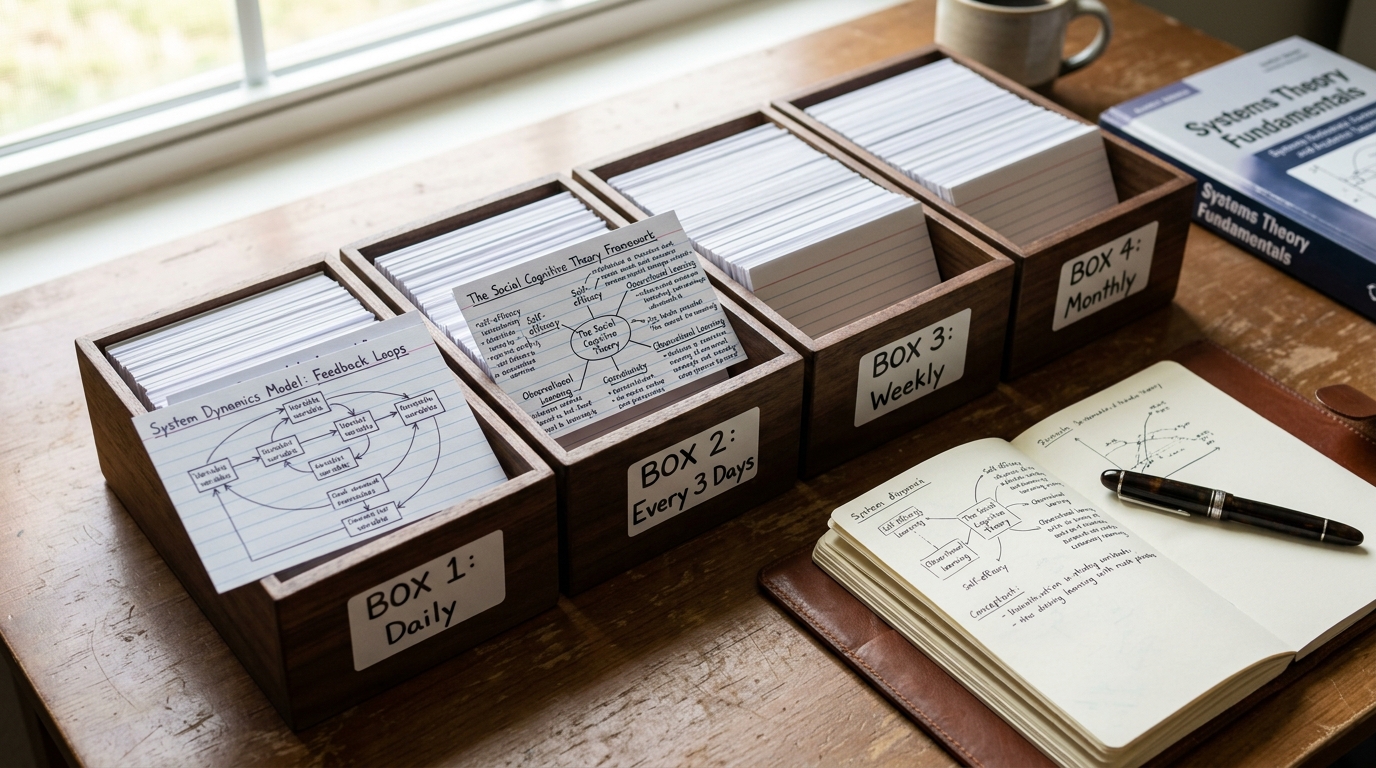
There is a consensus among experts that the Leitner System is among the most successful spaced repetition techniques for the retention of long-term memory. There has been a long-standing association between it and the learning of languages, the development of vocabulary, and the retention of simple facts. In accordance with their ability to retain information, students drop flashcards into various boxes, with more frequent study of challenging content and less frequent review of routine stuff. When it comes to working with complicated frameworks, multi-layered ideas, and interrelated systems, many professionals, students, and knowledge workers believe that this technique becomes less helpful. This is despite the fact that it works very well with straightforward material. From a practical standpoint, the Leitner System is capable of being modified to address complex learning issues that go far beyond simple memory. Learners are able to more successfully understand complex frameworks, professional procedures, technological systems, and strategic thinking models via the use of spaced repetition. This is made possible by rearranging the way knowledge is collected and evaluated.
How to Acquire Knowledge of the Traditional Leitner System
A number of boxes or categories that each indicate a distinct review period are the foundation of the traditional Leitner System. When a student successfully remembers information, the card moves on to a box that is examined less often. Responses that are incorrect shift the card back to an earlier box, where it will get more attention. This approach makes use of the spacing effect, which is a well-established theory that demonstrates that knowledge is kept more efficiently when it is revisited at increasing intervals over the course of time. The procedure is uncomplicated for vocabulary terms, historical dates, and basic facts since each card often has a single question and response. since of this, the approach is straightforward. When students seek to apply the same framework to ideas that cannot be reduced to single facts, they are confronted with a difficulty.
Several Reasons Why Complicated Frameworks Call for a Different Approach
Frameworks are essentially distinct from vocabulary phrases due to the fact that they incorporate interactions, dependencies, decision-making processes, and layered knowledge. Whether it is a company strategy model, a software architectural framework, a legal approach, or a scientific theory, each of these things has a multitude of interrelated components. It is possible that memorization of individual definitions will contribute to familiarity; nevertheless, genuine mastery needs a grasp of how the components interact within a wider system. It is common for traditional flashcards to be unsuccessful in these kinds of circumstances because they promote fragmented learning rather than integrated knowledge. One of the requirements for adapting the Leitner System is to move the attention away from memorization of individual facts and toward the reinforcement of conceptual links and practical application.
The Process of Deconstructing Frameworks Into Functional Components
Decomposing complicated frameworks into understandable functional pieces is often considered to be one of the most successful adaptations. Learners may segregate a framework into fundamental concepts, supporting mechanisms, decision criteria, implementation phases, and common exceptions rather of producing cards that just ask for definitions. This allows learners to better understand the foundation of the framework. Within the framework of the spaced repetition process, every component thereafter becomes a review target. Through the use of this structure, students are able to get a comprehensive comprehension of the framework as a whole while simultaneously having the opportunity to master its various components. The Leitner System is better suited for more complex topics that need analytical thinking since it places more of an emphasis on functional linkages than it does on isolated terms.
Utilization of Flashcards Based on Scenarios
The application of complex frameworks often occurs via decision-making rather than through simple recollection. Flashcards that are based on scenarios may help bridge this gap by showing circumstances that are very realistic and necessitate the application of framework concepts. As an alternative to inquiring about the meaning of a term, a card can explain a business difficulty, a technical problem, or a project situation and then inquire about which framework component need to get application. This method turns passive memory into active problem-solving, which is a significant improvement. The learners frequently practice putting ideas in context as they advance through the Leitner boxes, which strengthens both their ability to remember the concepts and their ability to apply them in real-world situations. Learning is more transferable and long-lasting when it is based on scenarios, which are reviews that closely reflect real-world use.
Establishing Knowledge Structures in a Hierarchical Order
Frameworks often have numerous levels of information in their structure. Changing the Leitner System such that it reflects these hierarchies has the potential to greatly enhance the results of learning. To better understand basic principles, intermediate linkages, and advanced applications, learners may construct unique card categories for each of these categories. Cards with lower levels of difficulty concentrate on fundamental concepts that are necessary for higher-level comprehension. The focus then moves to more complicated interactions and strategic issues after the underlying material has reached a stable state. This hierarchical arrangement is a reflection of the natural process of knowledge growth since it is hierarchical. In addition to this, it reduces cognitive overload by ensuring that more sophisticated ideas are constructed atop a strong foundation of information that is required.
Placement of Preference on Relationships as Opposed to Definitions
Many students make the error of seeing frameworks as collections of definitions, which is a common misconception. The ability to grasp the links between ideas is often more significant than knowledge, despite the fact that terminology is vital. If you want to ask questions about how different components impact one another, when certain parts become significant, or why certain actions yield particular results, you may redesign flashcards to pose these questions. If you want to stimulate deeper cognitive processing than mere definition recall, ask questions that investigate causation, interdependence, and relationships. Consequently, the Leitner System transforms into a system that aids in the reinforcement of mental models rather than the memorization of terms. It is because of this change that the system is much more beneficial for dealing with difficult academic and professional topics.
The incorporation of the reconstruction of the visual framework
It is sometimes simpler to grasp complex systems visually than it is to explain them orally. Learning via the use of flashcards that force students to rebuild diagrams, processes, or mental maps from memory is a successful adaptation. Learners get experience in reproducing the framework’s structure itself, as opposed to only memorizing individual pieces of knowledge. Through this method, one get a deeper understanding of the links between components and the architecture as a whole. In addition, visual reconstruction highlights understanding gaps that may not be apparent during more conventional question-and-answer assessments. Over the course of time, repetitive rebuilding helps to strengthen both memory and reasoning at the systems level, both of which are necessary for mastering systems with complicated frameworks.
Separation of Conceptual Weaknesses in the Tracking System
To a large extent, conventional Leitner systems address all faults in the same manner. Making a distinction between the various categories of errors, on the other hand, is beneficial to framework-based learning. When it comes to practical application or strategic decision-making, a student could have complete comprehension of the language, but they might struggle with it. It is possible to identify shortcomings with more precision if distinct evaluation categories are maintained for conceptual comprehension, application abilities, and advanced analysis. This focused approach enhances efficiency since review efforts concentrate on particular areas that want improvement rather to continuously reviewing material that is already well understood. This allows for more efficient data collection and analysis. This leads to a learning process that is more effective and individualized for each individual.
Utilising the System for the Purpose of Professional Instruction
There are a great number of professional fields that require frameworks that are well suited to an expanded version of the Leitner method. The methodology for project management, the procedures for developing software, the marketing systems, the financial analysis models, and the leadership frameworks all include interrelated ideas that would need an organized assessment. For the purpose of systematically reinforcing crucial information, professionals may make use of spaced repetition as an alternative to depending exclusively on reading or passive exposure. Maintaining a regular review schedule is an effective way to translate theoretical knowledge into practical competence. The more time that passes, the more intuitive frameworks become, which enables speedier decision-making and increased performance in real-world scenarios when complicated information must be applied under duress.
The Development of Long-Term Mastery Through the Use of Structured Review
The fundamental power of the Leitner System is not in its capacity to promote long-term retention via carefully planned review; rather, it is in its ability to make memory its exclusive characteristic. Through the application of the right modifications, it transforms into a potent instrument for understanding complex frameworks, rather than only recalling single data. Learners have the ability to turn spaced repetition into a full knowledge-development system by placing an emphasis on connections, practical application, hierarchical learning, and scenario-based reasoning. Complex topics demand more than just recognition; they require a profound grasp as well as the ability to apply it in a flexible manner. The modified Leitner technique offers an organized route toward the achievement of that objective, assisting students in the retention of complex ideas, the enhancement of their critical thinking abilities, and the development of competence that is accessible for a considerable amount of time after the original study sessions have concluded.