Practical Methods for Integrating Unilateral Balance Drills Into Existing Strength Routines
Practical Methods for Integrating Unilateral Balance Drills Into Existing Strength Routines
Unilateral balance activities help increase single leg stability, coordination, body awareness and control during strength training without having to make a total overhaul to an established workout routine. These exercises push the body to remain in alignment while one limb supports most or all of the weight, helping to reveal disparities between the left and right sides in balance, quality of movement, and muscular control. Unilateral balance training can complement squats, deadlifts, lunges and other compound movements for strength athletes and recreational lifters by building the stability needed to control challenging situations. But if you have too many drills or do them at the wrong time of the session, you can develop needless tiredness and get in the way of the main strength work. The movements should be chosen to meet the training goal, difficulty adjusted to the individual’s capacity, and the exercise order, volume, and recuperation managed for effective integration. Balance work should develop to controlled reaching, heavy actions, and single-leg strength exercises when suitable to go beyond just standing on one leg. By applying these drills selectively, lifters can boost the consistency of their movement, fix minor side-to-side differences and create a more balanced strength program without compromising their performance on their primary lifts.
Recognizing the function of unilateral balance training .
Unilateral balance training entails using one leg or one arm (depending on the activity) to maintain body position. Single-leg drills are especially beneficial for lower-body strength regimens because they involve muscles that stabilize the ankle, knee, hip and trunk. The foot and ankle help regulate contact with the ground, the hip musculature governs the posture of the pelvis and the trunk contributes to total postural stability. These demands mean that unilateral workouts are relevant to activities such as walking, running, climbing stairs and changing direction as well as strength movements conducted in the gym. However, balancing training should not substitute for progressive resistance training. You may enhance your postural control by balancing on one leg, but it will not immediately provide you the same strength adaptations as heavy squats, lunges or deadlifts. Instead, unilateral balance drills augment previous training by building coordination and control that may serve to enhance the execution of more challenging actions. Their value relies on the athlete’s goals, training history and current restrictions. The beginner can use easy supported exercises while the advanced lifter can add controlled single leg variants to challenge stability as well as strength and muscle endurance.
Choosing Drills to Match Your Training Goals
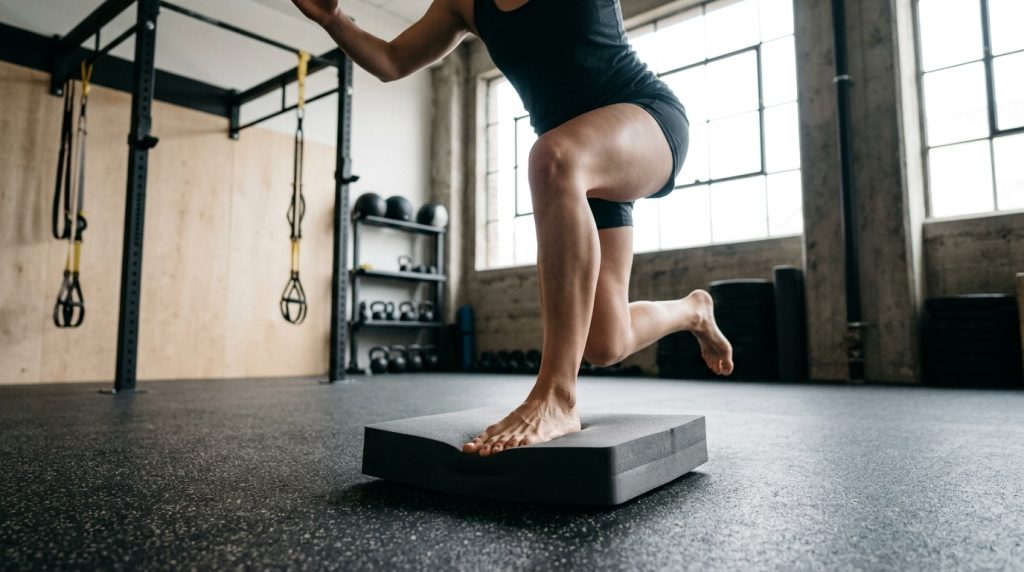
The best unilateral balancing workouts are the ones that meet a training requirement rather than adding complexity for the sake of it. Supported single-leg stands are a good way to start for beginners. Use a wall, rack or other sturdy surface to help you keep your pelvis level and foot position controlled while you build your balance. Once basic stability is improved, single-leg reaches and supported single-leg Romanian deadlifts can add in hip-hinge coordination. Split squats, reverse lunges and step-ups marry unilateral loading with strength development, so they’re good choices for lifters who seek balance challenges but don’t want to lose their resistance-training focus. The more skilled athlete may add in single-leg Romanian deadlifts with light dumbbells, controlled step-downs, or multidirectional reaches as long as they can keep constant movement quality. Effective balance training does not require unstable equipment, and heavy workouts performed on very unstable surfaces may decrease the ability to create force safely. Select drills that fit the movement patterns you need in your regimen. A runner might be more focused on single-leg control and landing mechanics, and a powerlifter might employ unilateral work to supplement lower body training and to deal with noticeable disparities in control. The exercise should test the skill required, but not be so tough that posture, alignment, or execution break down regularly.
Putting Balance Drills in the Right Spot in Your Workout
Order of exercise is a huge factor in the quality of both balance training and primary strength work. If your major focus is balance and coordination, low-fatigue activities are usually best done after the warm-up and before heavier compound lifts. Now the athlete is ready to move and has not built up a lot of muscular weariness that might interfere with control. For example, a lifter would do two fast sets of supported single-leg stands or controlled reaches before starting squats. But exercises that require unilateral effort, such as loaded single-leg Romanian deadlifts or high-rep lunges, might tire the legs and torso and are less ideal just before max-strength attempts. These moves could be better suited after your major lifts or as an accessory. Its correct location depends on whether the primary purpose of the exercise is balance skill or maximal strength performance. If you’re gearing up for a heavy squat, don’t turn your warm-up into a tough balance workout. Or an athlete who wants to improve single-leg coordination can arrange some targeted balancing work early in a lighter training day. The key to maintaining the aim of the workout, while allowing the drills to contribute in a meaningful way to the overall program, is to keep the first balance component brief and specialized.
Adding Unilateral Drills to Your Existing Strength Routine
Rather than adding a new training block, unilateral balance training can be incorporated by modifying exercises already existing in a strength routine. Reverse lunges, split squats, step-ups and single-leg Romanian deadlifts all demand the athlete to control body position while loading one leg more than the other. If a lifter is currently doing bilateral squats they may throw in a little split squat practice after the main exercise with a light weight and a regulated range of motion. Someone performing traditional Romanian deadlifts may sometimes replace a light single leg version during accessory training to stress hip stability and balance. If the step height permits for controlled foot placement and constant pelvic alignment, step-ups can be programd in conjunction with existing lower-body workouts. And you want to separate a unilateral strength drill from a pure balance exercise. The loaded split squat is mainly a test of strength and muscle control, and the single-leg stand is a test of postural stability under a relatively low external load. Both are valuable, but they call for a different kind of training. Do not replace all bilateral exercises with unilateral exercises, bilateral exercises are still crucial for developing force generation in a symmetrical loading pattern. A good program can use both approaches depending on the athlete’s goals and ability to recuperate.
Dealing with sets, reps and training intensity
Balance drills are often best when done in a short, controlled set that keeps the technique consistent throughout the practice. If you are only looking to practice static balancing training, starting with 2 or 3 sets of about 15-30 seconds per side is a good practical approach. Dynamic drills may involve five to eight controlled repetitions per side depending on the movement, experience level of the athlete and the amount of difficulty. These numbers are starting points, not universal needs, and certain athletes will need shorter sets to remain in good alignment. For loaded unilateral strength exercises, a popular starting point is two to three sets of six to twelve repetitions per side with a weight that allows for stable, controlled movement. The balance should not degrade appreciably before the completion of the set, and repetitions should not be pressured to attain a predefined number. Excessive fatigue can affect the quality of movement and can make it difficult to distinguish between a true balancing constraint and transitory muscular fatigue. Rest times should be appropriate to the demands of the workout. Simple balance exercises may require little recovery, whereas heavier single-leg exercises tend to need longer rest periods to maintain strength and coordination. Start with a small total volume , see how the drills fit into your overall workout , and progressively ramp up the difficulty or the volume , but not both at the same time .
Dealing with Side to Side Differences without Creating Imbalances
Unilateral exercises are easier to use to see changes in balance, coordination and strength between the left and right sides. You may feel less secure on one leg during a single leg stand and notice better control on the opposing leg during step-downs or single leg hinges. These are frequent differences and do not necessarily imply an injury or major muscular imbalance. Before you modify anything, compare both sides under same conditions, same shoe, same surface, same range of motion, same repetition target. Begin with the less coordinated side if it helps to know a working level then match the same controlled repetitions on the stronger side. Don’t just give the weaker team a bunch of sets, because that can just create tiredness without fixing the underlying reason for the gap. Instead, modulate exercise intensity so that both sides can reach the desired action with acceptable technique. For example, if a lifter can’t maintain pelvic control on an unsupported single-leg hinge, he or she could utilize mild fingertip support until coordination improves. Note observations across numerous sessions, rather than measuring progress from a single session. If a difference is associated with persistent pain, frequent giving way, numbness, or substantial loss of function, then expert assessment is more required than just increasing unilateral exercise volume.
Advancing to Balance Challenges in a Safe and Systematic Way
Progression should be to more difficult unilateral balance drills without loss of control or risk. A useful starting sequence advances from supported static poses to unsupported holds, to controlled reaching tasks, to loaded unilateral motions where appropriate. For instance, an athlete might start with a supported single-leg stand, advance to a free-standing hold, and then do single-leg reaches while keeping the pelvis level. Next, a small dumbbell may be added during the single-leg Romanian deadlift, if the athlete can maintain a firm stance and controlled hip hinge. Other ways to progress the exercise include expanding the range of motion, slowing down the lowering portion, or adding a little bit of resistance. Only one key variable should be raised at a time so the athlete can determine which modifications improve or degrade movement quality. Highly unstable surfaces are not required for most strength training goals and may add demands that are less specific to the desired ability. When learning unusual moves, train on a clear, nonslip surface and use support. Progress when the present version can be done consistently over multiple sessions not because the exercise has grown familiar. The technique builds practical control and reduces the incentive to pursue challenging variations before basic movement abilities are mastered.
Weekly Programming / Training & Recovery Balancing
When considering the entire volume of work performed by unilateral balance drills, one must consider the demands of squats, deadlifts, lunges, jogging, and other activities that stress the lower body. Minor fatigue is commonly produced by low-level balance holds, but difficult single-leg strength workouts can cause substantial muscle discomfort, especially when they are initiated suddenly or include novel ranges of motion. High-volume, single-sided work directly before or after a tough lower body exercise may hinder recovery and diminish performance in following workouts. A realistic solution is to include short balancing drills in two or three sessions per week, with the more difficult unilateral strength work saved for dedicated accessory blocks. Low-fatigue balance activities on lighter days may be appropriate for athletes with frequent lower-body training, as long as they don’t aggravate existing issues or interfere with recovery. Introduce new exercises with attention to discomfort, quality of movement, training performance, and perceived effort. If the main lifts start to descend or you are feeling chronically fatigued, decrease the unilateral volume before increasing complexity. Weekly planning should also include sports practice, work responsibilities, and other activities that need single-leg coordination. The purpose is to augment the current program, not to establish a rival source of fatigue with its fundamental objectives.
Outcomes Evaluation and Progress Maintenance
One balancing test does not allow for the assessment of the success of unilateral balance training. Instead, changes in movement control, exercise consistency, and performance need to be looked at. Good markers are pelvis staying level during single leg stand , being able to control the descent during step downs , foot being stable during lunges , and being able to complete the recommended repetitions without repeatedly losing balance . You can record hold time, successful reps, assistance necessary, and resistance used for loaded workouts. The conditions under which the tests are performed should be consistent so that changes are not due to differences in footwear, surface or difficulty of exercise but a true improvement. Postural control and force generation are connected, although different training characteristics and balance improvements can also be made without rapid increases in peak strength. Follow the overall program for the key strength lifts. Use unilateral drills to support coordination and address specific difficulties. If a drill is getting simple, progress it a little by adding in a regulated range of motion, low resistance or more challenging movement patterns. Don’t introduce more modifications only to keep workouts interesting. A handful of well-selected exercises executed regularly can be more valuable than changing drills often without a clear purpose. By combining unilateral balance work with appropriate exercise selection, controllable volume, and steady increases, lifters can improve their single-leg control without sacrificing the structure and effectiveness of their existing strength programs.