Programming Rest Intervals Based on Barbell Velocity Loss Instead of Fixed Timers
Programming Rest Intervals Based on Barbell Velocity Loss Instead of Fixed Timers
Programming rest intervals is an important aspect of resistance training since the length of time spent recovering between sets can affect strength output, muscle fatigue, and overall quality of the session. Many traditional training plans have prescribed rest times, such as two minutes between sets or three minutes after heavy compound exercises. This strategy provides a straightforward structure, but does not take into account the variances in individual recovery rates, or changes in tiredness during a workout . Barbell velocity loss offers a different approach, employing changes in lifting velocity to help determine when an athlete should rest, decrease training demands, or terminate a set. The constant measurement of barbell velocity can provide significant information about neuromuscular exhaustion and the athlete’s capacity to continue force generation. This method is especially pertinent for strength athletes, powerlifters, and coaches striving to balance training intensity with movement quality. However, velocity readings must be evaluated according to the type of exercise, the load, and the training goals. Knowing how to program rest intervals with velocity loss might help athletes make better training selections without incurring excessive fatigue.
What is Barbell Velocity and How Can It Be Used in Training
Barbell velocity is the speed at which a barbell travels through a repetition of a lift, usually measured in meters per second. Coaches can evaluate the lifting performance on the basis of mean concentric velocity, mean propulsive velocity, or peak velocity, depending on the measurement system. Mean concentric velocity is the mean velocity of the bar during the concentric portion of the lift while peak velocity is the greatest velocity during the concentric portion of the lift. These are different metrics and should not be viewed as interchangeable. Bar speed can decrease in successive sets as muscular tiredness accumulates, especially when the resistance is constant and the athlete seeks to lift each repetition with maximal intended acceleration. Monitoring this decline can help to recognize when performance is going downhill. However, barbell velocity is not only influenced by exhaustion. The result depends on load, technique, range of motion, exercise selection and the intention of the athlete to accelerate. A slow repetition under maximal effort is not an unexpected slow repetition; it is a deliberate one. Velocity is therefore a useful reference for determining rest intervals if the measurement conditions are consistent.
What velocity loss can tell us about accumulated fatigue
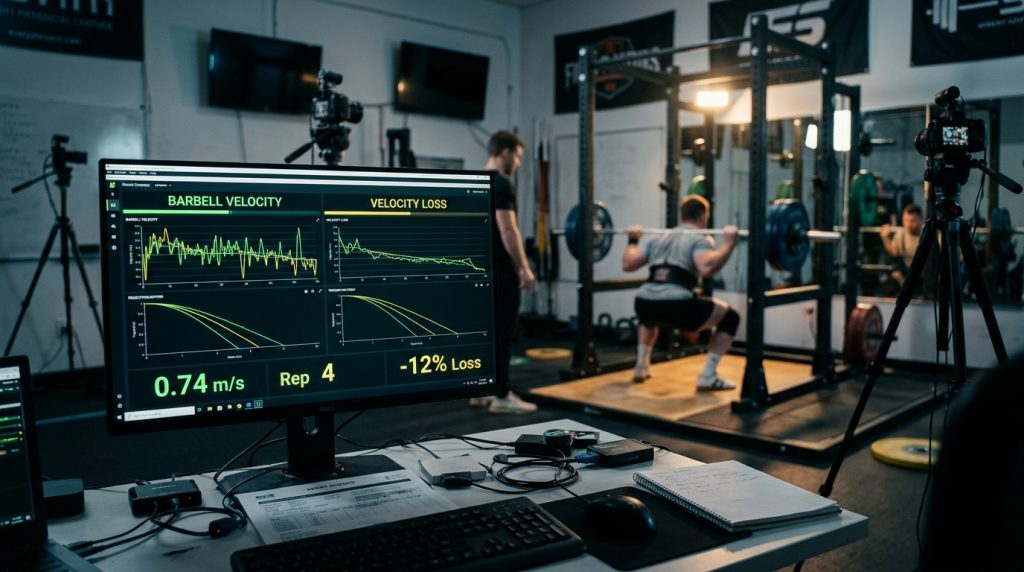
Velocity loss is the percentage drop in barbell speed compared to a predetermined reference repetition, usually the quickest repetition in a given set or a predetermined baseline. For instance, if the first repetition is done at 0.80 meters per second and a subsequent repetition is done at 0.64 meters per second, the decrement is 20 percent. The change can be used to estimate how much performance has decayed during the set. In general, lower velocity-loss thresholds limit the accumulation of tiredness, while higher thresholds permit more repetitions and typically result in greater weariness. The proper threshold is dependent upon the training goal, exercise, resistance, and the athlete’s experience. Power-oriented sessions tend to focus on the aim of maintaining a high movement velocity, but hypertrophy-oriented sessions could be more accommodating of a higher velocity decrease when the goal is to accrue difficult muscular work. But loss of speed is neither a direct measure of muscle injury or complete physiological recovery. Two athletes can experience similar velocity changes but differing levels of effort. Velocity is not an absolute measure of readiness for coaches, it should be viewed as a percentage and interpreted with technique, quality of repetitions, training history and subjective tiredness.
Choosing Velocity-Loss Thresholds for Various Objectives
A velocity-loss threshold limits the reduction in bar speed before the set finishes or training parameters change. A relatively low threshold, commonly in the range of 10 to 15 percent, may assist limit excessive movement speed and exhaustion during the development of explosive power. Depending on the load and the athlete’s programming needs, strength-based training may allow for slightly higher losses. Hypertrophy training can lead to greater decreases in velocity since it is sometimes more vital to accumulate enough muscular effort than it is to sustain peak speed on every rep. In structured training, thresholds of about 20 to 30 percent are commonly used, although these levels should not be used automatically in every exercise or athlete. Increased velocity losses can lead to increased fatigue and may have a negative impact on subsequent activities. The desired modification should therefore be the correct limit, not a universal rule. Coaches should also take into account the accuracy of their measuring equipment and the reliability of velocity readings for the chosen exercise. Where measurement accuracy is inadequate, some combination of perceived effort, speed of repetition and technique may be more valuable than precise-looking but incorrect percentages.
Rest Intervals Programming For Recovery Of Barbell Velocity
Bar speed can be used in velocity based rest programming to identify whether an athlete is ready to execute the following set. Instead of resting the same amount of seconds after each set, the lifter can perform a standardized preparedness repetition with a constant load and compare its velocity to a reference value. If the repetitions are still significantly slower than predicted, further recovery may be needed before another hard set may be started. If velocity is within the athlete’s typical range, and technique and subjective readiness are adequate, then the following set may be appropriate. However, this strategy should be used with care, since a readiness repetition causes some fatigue itself, especially when the test is with a challenging load. If you want to check your recuperation without really influencing your next set, a light, standardized movement may be better. As an alternative you may monitor velocity on the first repetition of each working set and use this to guide the length of subsequent rest periods. Rest adjustments should be reasonable, slight additions or subtractions, not constant modifications with each little variation. The aim is to make the decision-making process better, not to make training more complicated.
Velocity tracking devices and precise measurement methods.
Accurate velocity-based programming requires accurate data collection. Barbell velocity during resistance exercises can be estimated using linear position transducers, inertial measurement devices and a few verified camera-based techniques. Different devices have different setup needs, different ways of measuring and different dependability, therefore it’s important for athletes to know what velocity metric their device is reporting.” Whenever possible, the same instrument and measurement parameters should be used throughout a training block. The bar path, range of motion, sensor attachment and lifting technique should be constant as changes in these can alter reported data. Lifters should undergo multiple familiarization sessions to learn how to accomplish repetitions with consistent maximal planned acceleration before establishing a baseline. Baseline velocity should be measured at a defined load under similar conditions and not selected from an atypical fast or slow repeat. Also watch for odd changes in device readings, especially if the bar goes through a different range of motion or the sensor gets displaced. Without specialized equipment , velocity loss can be assessed by video analysis or by closely following the speed of repetitions . The latter approaches are less precise . It is better to have consistency in the measurements than to have more data than you can properly analyze.
Changing Training Load When the Velocity Drops Too Fast
Velocity loss can be used to determine if a planned set or session is causing more fatigue than desired. If the bar speed starts dropping off quickly, even with enough rest, it can be a sign the athlete is building fatigue from too much volume, too much resistance, not enough recovery or some combination of these. Instead of having to complete the original number of repetitions, the lifter can stop the set at the chosen threshold and decide if more sets are still acceptable. For example, an athlete doing speed squats may halt a set when the bar velocity drops below the target threshold, maintaining focus on the explosive movement. If the athlete continues to perform poorly during a strength exercise, he or she may decide to increase rest periods or decrease remaining effort. Gradual declines in velocity over a few of sessions can also be a sign that the weekly training loads need to be reassessed. But just because you have one slow repeat doesn’t mean you should throw the rest of your workout out the window. Measurement inaccuracy and technical inconsistencies can affect results. “Before making drastic programming adjustments, coaches should search for common patterns and other markers of readiness.” This helps to keep training quality while lowering the risk of building up needless weariness.
Velocity Based Training Integrated with Traditional Training Principles
Velocity-based rest periods work best when supplemented with known resistance training techniques, not as a replacement for all traditional programming. Fixed rest intervals are still useful for novices, general fitness training and workouts where measuring velocity gives little benefit. For example, modest isolation motions may not require specialist tracking, as technique, perceived effort and a basic rest schedule can all serve as adequate coaching. Velocity tracking can be more useful for heavy compound workouts and power based movements as changes in bar speed can tell you a lot. Coaches should also consider training phase, exercise order, total weekly volume and proximity to muscular failure. Velocity thresholds won’t help if your workout selection is inadequate or your training plan is unrealistic. Likewise, an athlete should not reduce rest only because bar speed looks normal if breathing, balance or technique is affected. Interpretation needs to be flexible because of individual variances in recovery and training experience. The employment of velocity measures, sound programming, consistent delivery, and subjective feedback allows for a more thorough framework for managing tiredness. The goal is to include objective information where it provides value, and to keep the training process simple and sustainable.
Monitoring Progress and Adjusting Velocity-Based Programming
With a proper velocity based program you should see measurable increases without having to constantly change and break the consistency of your training. Athletes can track first-repetition velocity, velocity decrease across sets, rest length, working load, repetitions, and perceived exertion. Over time, these statistics can show whether the same resistance is moving quicker, whether recovery between sets is improving, or whether excessive velocity loss is continuously occurring at a certain workload. Better performance at a given load could be an indication of increased force generation, technical skill, or both. However, comparisons should consider changes in exercise technique, range of motion, and measurement conditions. Coaches should also evaluate whether the velocity thresholds selected will be conducive to the desired training outcome. If the power output drops significantly after a long rest, it may be better to reduce the set volume than to wait indefinitely for full recovery. If, in contrast, the performance is stable and the regeneration is always sufficient, the athlete can perhaps cope with the expected workload without delays. Velocity data should be studied over numerous sessions and not in isolation. Regular evaluation permits the tuning of the training variables according to the actual performance and not only on the basis of pre-determined timers.
Constructing a sustainable rest-interval strategy based on velocity loss
Programming rest periods around barbell velocity loss represents a useful tool for individualizing recovery when movement speed can be reliably assessed. This technique is especially beneficial when the main goal is to save power, assess strength performance or reduce fatigue in challenging compound lifts. To execute it effectively, you need a well-defined velocity metric, a dependable reference value and a threshold adequate for the training aim. Athletes can then use velocity adjustments within a set to control repetitions and monitor trends relating to recovery between sets. But velocity should be one piece of a bigger puzzle of decision-making that takes in technique, perceived effort, respiration and the entire training plan. If equipment is unavailable or the exercise does not derive a meaningful advantage from velocity tracking, fixed rest times may still be suitable. Too much precision should never get in the way of good coaching judgment, especially when readings are inconsistent or exercise conditions change. By combining reliable monitoring, goal-specific thresholds and progressive programming tweaks, athletes can make rest intervals more sensitive to their actual performance. This provides constant training quality, more careful fatigue management, and a disciplined long-term approach to developing strength and power.