Combining Pomodoro Work Sessions with Iso-Hold Core Exercises for Remote Professionals
Combining Pomodoro Work Sessions with Iso-Hold Core Exercises for Remote Professionals
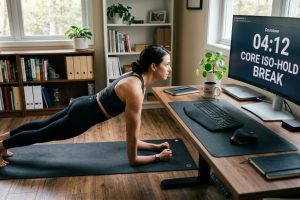
When working remotely, professionals often confront difficulties in maintaining their productivity while also placing an emphasis on their physical wellness. Sitting at a desk for extended periods of time may result in bad posture, a weakening of the core muscles, and mental exhaustion. Short, concentrated work periods, such as those provided by the Pomodoro Technique, combined with brief iso-hold core exercises provide an excellent answer to this issue. Both concentration and job efficiency are improved by the use of the Pomodoro technique, which consists of 25-minute periods of intense work followed by brief breaks. By doing isometric core holds during breaks, remote workers may strengthen their abdominal muscles, improve their posture, and lessen the physical strain that comes with sitting for extended periods of time. Some examples of these holds are planks, hollow holds, and side planks. This integrated strategy helps to foster mental clarity, physical resilience, and sustainable work habits without necessitating lengthy gym sessions or the use of specific equipment.
Familiarizing Oneself with the Pomodoro Technique
The Pomodoro Technique is a time management strategy that aims to enhance concentration, productivity, and the completion of tasks. In most cases, it is comprised of twenty-five minutes of continuous work, followed by a five-minute break, with lengthier breaks occurring every four cycles. The presence of this structure helps to alleviate mental fatigue and encourages continuous focus. It is possible for remote workers to have interruptions at home; thus, Pomodoro sessions are beneficial for enhancing productivity since they set defined limits. This strategy, when combined with physical exercise during breaks, not only improves mental clarity but also mitigates the consequences of sedentary labor, which may be detrimental to one’s health.
Why Iso-Hold Core Exercises Are Beneficial to Your Body
Maintaining a static posture while under strain without moving is the focus of isometric holds, which are also known as iso-hold core workouts. Planks, hollow holds, and side planks are exercises that have the ability to work the deep abdominal muscles, obliques, and spinal stabilizers. These exercises are essential for improving posture, balance, and core endurance, all of which are essential for working sat for extended periods of time. Iso-holds, in contrast to dynamic exercises, have a low impact and need a little amount of space, making them an excellent choice for use in domestic settings. When done on a regular basis, they have the potential to ease back pain, improve spinal alignment, and strengthen the muscles that maintain the trunk during occupational tasks as well as activities undertaken on a daily basis.
Improving the Organization of Pomodoro Sessions Through Core Iso-Holds
To successfully include iso-hold exercises into Pomodoro sessions, careful planning and consistent execution are required. A plank for sixty to ninety seconds, followed by a side plank for thirty seconds on each side, may be performed by remote professionals during the typical five-minute break. This exercise can be repeated as many times as time permits. This guarantees that each break will contain concentrated physical exercise without completely exhausting the limited amount of time available for recuperation. By gradually adapting to greater strain, the core muscles are able to improve their strength and endurance, while also complementing the cognitive advantages that are associated with intense work phases.
Iso-Holds: Keeping the Correct Form During the Exercise
It is essential to do iso-hold exercises with correct form in order to fully reap the advantages of these exercises and to avoid injury. Maintaining a straight line from the head to the heels, avoiding drooping hips, and properly engaging the abdominal muscles are all important while doing planks. While performing side planks, it is important to make sure that the shoulders are stacked over the hand or elbow that is providing support, and that the core is engaged to prevent the torso from rotating. In order to guarantee that brief sessions during Pomodoro breaks achieve substantial strength improvements without putting additional pressure on the neck, lower back, or shoulders, it is important to monitor alignment and muscle activation.
Making Adjustments to Intensity Based on Individual Fitness Levels
It is possible to modify iso-hold workouts such that they are appropriate for individuals of varying fitness levels. In order to begin, beginners might begin with knees-on-the-ground planks or shorter hold durations. As their core strength increases, they can progressively increase the length and intensity of their planks. Weighted vests, prolonged hold periods, and dynamic variants such as plank leg lifts are some of the options that more experienced pros may integrate into their performance. By adjusting the intensity, you can assure that every person will experience progressive overload, which will improve both muscle endurance and stability over time while allowing you to keep sustainable energy throughout the workday.
Taking into account movement in between two holds
Although iso-holds are effective in strengthening the core, incorporating short movement in between holds may further improve circulation and decrease stiffness throughout the body. During a Pomodoro break, you may supplement the static activity by just strolling about the room, doing shoulder rolls, or twisting your spine gently. It is important to ensure that muscles obtain both strength and functional flexibility by alternating between isometric tension and mild mobility. This helps to reduce the danger of tightness that may result from sitting for an extended period of time and promotes overall musculoskeletal health.
Performance and Productivity Monitoring and Analysis
Remote workers are able to monitor their job productivity as well as their physical development, which allows them to optimize their advantages. The cognitive advantages of the Pomodoro technique may be better understood by monitoring several aspects of the process, such as the completion of tasks, mental clarity, and energy levels after breaks. While simultaneously tracking the length of planks, side plank holds, and felt core engagement, it is possible to make gradual improvements. By maintaining a consistent monitoring system, one may guarantee that the combination of concentrated labor and core training yields measurable outcomes in terms of both productivity and physical conditioning.
It is possible to establish a synergistic regimen that improves mental attention, physical resilience, and posture for remote workers by combining Pomodoro work periods with iso-hold core exercises. In order to develop their core, offset the negative effects of extended sitting, and maintain high levels of productivity throughout the workday, people may improve their core by scheduling work intervals, keeping appropriate form, modifying intensity, and integrating mild exercise. When it comes to attaining both mental and physical well-being in a home-based work environment, this integrated approach provides a solution that is both practical and efficient in terms of use of time.