How to Use “Visual Anchoring” and Mindfulness to Stay Calm During High-Stakes Exams or Presentations.
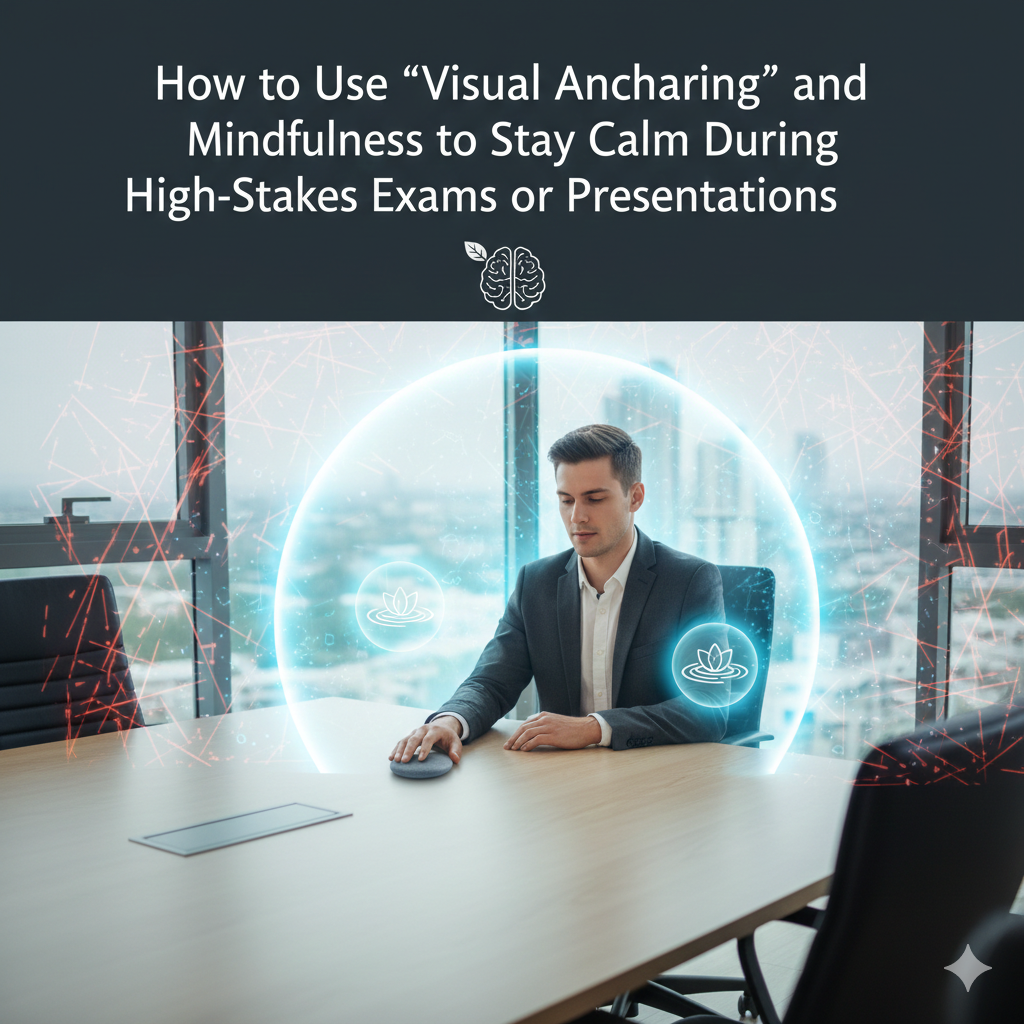
How to Use “Visual Anchoring” and Mindfulness to Stay Calm During High-Stakes Exams or Presentations.
It is common for the brain to interpret the pressure that is being applied during a high-stakes test or presentation as a physical danger, which causes the “fight-or-flight” response to be triggered. In response to this physiological change, blood flow is redirected away from the prefrontal cortex, which is the region of the brain that is responsible for logic, memory recall, and sophisticated thinking, and toward the amygdala, which is responsible for fundamental instincts related to survival. Students often “blank” on a question that they are really familiar with, and this is also the reason why speakers lose their train of thought in the middle of a statement. In order to combat this, you will need to use strategies that provide a signal of safety to the neurological system. This will enable you to avoid the panic reaction and maintain access to your cognitive resources at the times when you really need them the most.
A Scientific Approach to Visual Anchoring
The practice of visual anchoring is a method of grounding that involves tethering your attention to the current moment by using a particular physical item that is present in your surroundings. The majority of the time, when anxiety starts to spin out of control, your thoughts “leak” into the future, where you worry about failing, or into the past, where you dwell on errors. You may provide your brain a “baseline” of reality by selecting a stationary, motionless object in the room, such as the edge of a desk, a certain pattern on the wall, or a personal item such as a ring or a watch. This will allow your brain to better process the information it receives. The brain is forced to move from abstract internal anxiety to tangible exterior facts as a result of this simple act of observation, which has the impact of slowing down the sympathetic nervous system.
During the course of the Task, the “Micro-Reset” was implemented.
The term “micro-reset” refers to a mindfulness intervention that lasts for 10 seconds and may be performed in the midst of an examination or speech without anybody seeing anything. In the event that you experience a wave of terror, you should immediately stop what you are doing and concentrate totally on your visual anchor. Pay attention to its hue, its texture, and the way the light interacts with its surface. Take a deep “box breath” which consists of inhaling for four seconds, holding for four seconds, then expelling for four seconds while you are doing this. This combination of visual attention and regulated breathing functions as a circuit breaker for the stress reaction, draining away excess adrenaline and enabling your logical brain to recover control of the story. Visual focus is a crucial component in the stress response.
For the purpose of information retrieval, constructing a “Memory Anchor”
Visual anchoring is another method that may be used for the purpose of memory recovery. During your study sessions, you should set a special item on your desk, such as a little stone or a certain pen, and allow yourself to concentrate on that thing while you are working to understand a challenging idea. You are establishing a “neural association” between the knowledge and the item in question by carrying out this action. If you bring the same pen with you to the test, gazing at it may serve as a visual trigger that provides you with the ability to “unlock” the memory that is connected with it. Because the item acts as a physical bridge between your planned study environment and the high-pressure exam venue, this method offers a feeling of psychological comfort to the individual.
Utilizing a “External Observer” Mindset to Its Full Potential
The capacity to monitor your thoughts and bodily sensations without getting “entangled” in them is the essence of mindfulness when it comes to high-pressure situations. Rather of thinking, “I am failing,” you teach yourself to think, “I am noticing a feeling of tightness in my chest and a thought about failing.” This is better than thinking, “I am failing.” Through this slight adjustment in terminology, a “metacognitive” gap is created between you and the fear that you are experiencing. In order to avoid your worry from snowballing into a full-scale panic attack, you should try to perceive your anxiousness as a brief passing weather system rather than a permanent part of your personality.
Feeling the Support Through Proprioceptive Grounding Training
A technique known as “proprioceptive grounding” includes concentrating on the physical points of contact between your body and the surroundings. This technique is in addition to the use of visual anchors. Feel the weight of your body in the chair, the pressure of your feet on the floor, or the texture of the pen in your palm for a moment. Take a time to really appreciate these sensations. When you get this sensory information, it conveys to the “somatosensory cortex” of your brain that you are being physically supported and that you are secure. Your mind is less likely to wander into the chaotic “what-if” scenarios that feed performance anxiety when you feel anchored in your body. They are the source of performance anxiety.
Examining Nervousness Through the Lens of Excitement
When it comes to the bodily manifestations of anxiety, such as a racing heart, sweaty palms, and heightened awareness, the feelings are almost similar to those described for excitement. This technique is referred to as “anxiety reappraisal.” Instead of attempting to push yourself to be “calm,” which is a low-energy state that is impossible to obtain during a test, try to describe your physiological arousal as “excitement” or “readiness.” This will help you become more comfortable with the examination. Through the process of convincing yourself, “My body is pumping adrenaline to help me focus and perform,” you are able to change the tension that you are experiencing from a barrier into a useful tool. This adjustment in viewpoint enables you to make the most of the additional energy rather than allowing it to overwhelm you and leaving you feeling overwhelmed.
A Pre-Performance Ritual That Is Being Established
The most efficient method for ensuring that these strategies are successful under pressure is to include them into a pre-performance ritual that is consistent with the methodology. You should work on your visual anchoring and grounding skills during the 10 minutes that are left before the clock begins. The brain is then prepared to detect these impulses as “cues” for attention as a result of this. You will find it much simpler to keep your calm once you enter the high-stakes atmosphere since the ritual has already reduced the amount of tension that you are experiencing at the beginning of the experience. By using this preventative strategy, you can be certain that your performance is a reflection of your genuine capabilities and the amount of preparation you have put in, rather than being a result of a quick stress reaction.